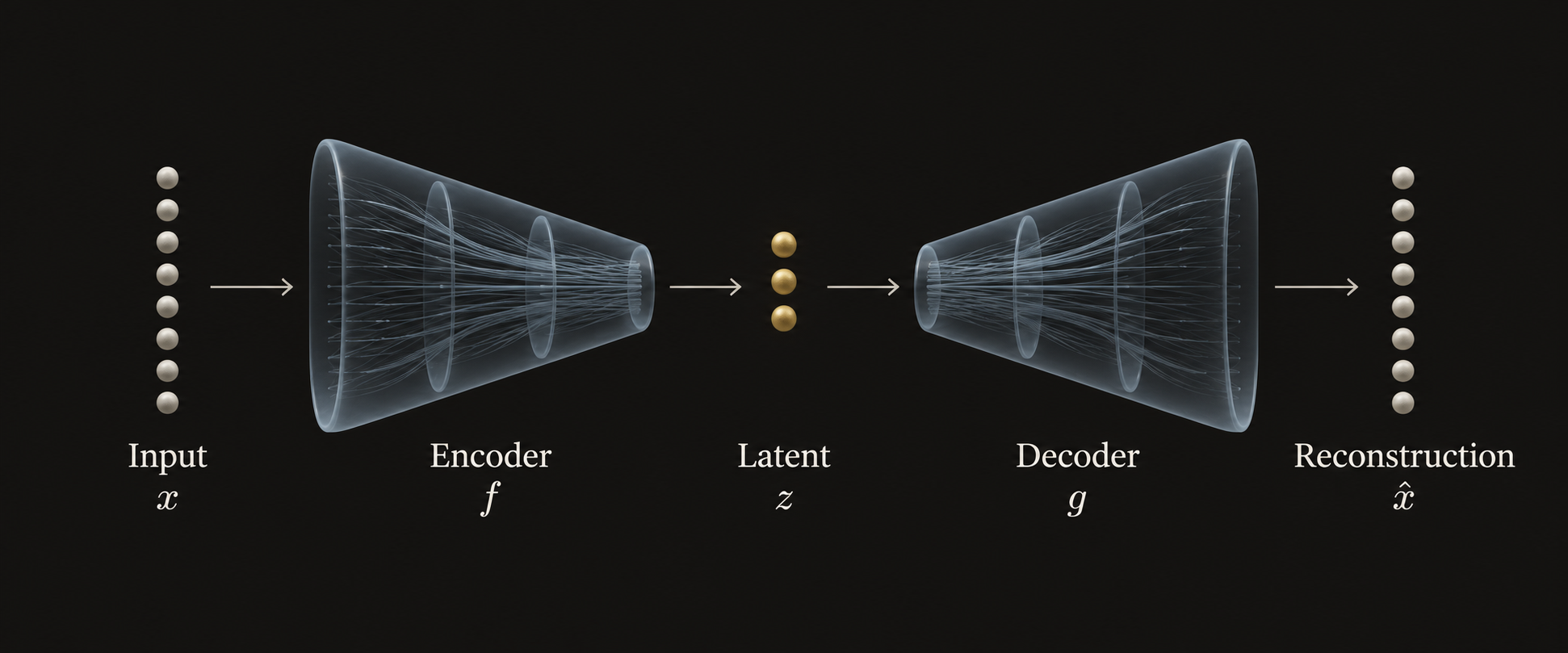
How does experience become a person's perceived world, then unfold into language, judgment and action? Encoding and decoding give that question an image.
1. What Makes Something “Faulty”?↗
The early note compared depression to a faulty encoder and mania to a faulty decoder. The analogy moved too quickly. Before specifying the input or what had changed, it had already assigned a diagnosis to a component.
NIMH's accounts of depression and bipolar disorder describe symptoms, their course and changes in everyday functioning. They do not establish that component-by-component correspondence. Calling an experience an encoding failure still requires a task that can distinguish competing explanations, not just a word that sounds apt.
First, make the machine in the diagram explicit. A basic autoencoder uses an encoder to map input to a representation , and a decoder to produce a reconstruction :
The two sets of parameters are and . With squared reconstruction error, a training objective can be written as:
There are numerical inputs, and the loss measures reconstruction differences. “Faulty” is always relative to a task and a measure. This error does not turn itself into a measure of meaning, happiness or mental health.
2. Good by the Metric, Good in Life↗
This is also where things become interesting. Something “bad” need not be bad in every sense; something “good” need not be good in every sense either.
When an encoder and decoder achieve lower reconstruction error, the score has genuinely improved. But if the question is whether the representation helps with another task, the score has not answered everything. The autoencoder chapter of Deep Learning notes that copying inputs alone need not produce useful features. Constraints on the representation and the learning objective matter too.
The point is to complete the judgment: good at what, and for whose use?
Likewise, an offer from a prestigious university can show that someone passed a selection process. It does not automatically reveal how they treat others, what success means to them, or how they will live afterward. Excellence recognized by selection and a life worth pursuing do not share a single transcript.
Looking at people through machines brings this question into view: is the objective being optimized still the thing that was wanted in the first place? The question continues in Meritocracy and the Parts of Us It Cannot Measure.
3. Null: One Word, Another World↗
Language has another interesting property. The same word can change the way it is understood when it moves into a different field.
I remember an IELTS teacher explaining null as “empty” or “zero.” After studying pointers, the word no longer belonged only to a vocabulary list. For example, a null pointer value in C++ has a specific place in a formal system and is distinguishable from other pointer values. A broad word, “empty,” becomes a concept with conditions on its use.
This does not mean that technical language has revealed the ultimate meaning of nothingness. What changes is the background needed to understand the word. It no longer arrives alone. It brings objects, rules and possible errors with it.
Borrowing a word also means attending to the world in which it works.
Encoding, decoding, “good” and null all have boundaries of this kind. The language of machines can make previously vague choices visible when it is brought back to people. But if the tasks that gave those words their meaning are forgotten, an explanation can become a misunderstanding with a different vocabulary.